
Brevard VINELink Release Coverage
Florida's program is Victim Information and Notification Everyday, or VINE. FDC Victim Services administers it statewide. The official program description says it is free, confidential, available by phone, web, and app, and receives events from all Florida county jails as well as FDC custody and community supervision.
For a Brevard County jail detainee, VINE can report a status change supplied by BCSO. For a state inmate, Florida VINE may provide current location or tentative release information and events such as release, transfer, escape, work-release placement, return to custody, another-jurisdiction transfer, or death. Supervision events can include an absconding report, return from absconder status, a supervision change, or death.
The Florida VINE landing page is the official state entry.
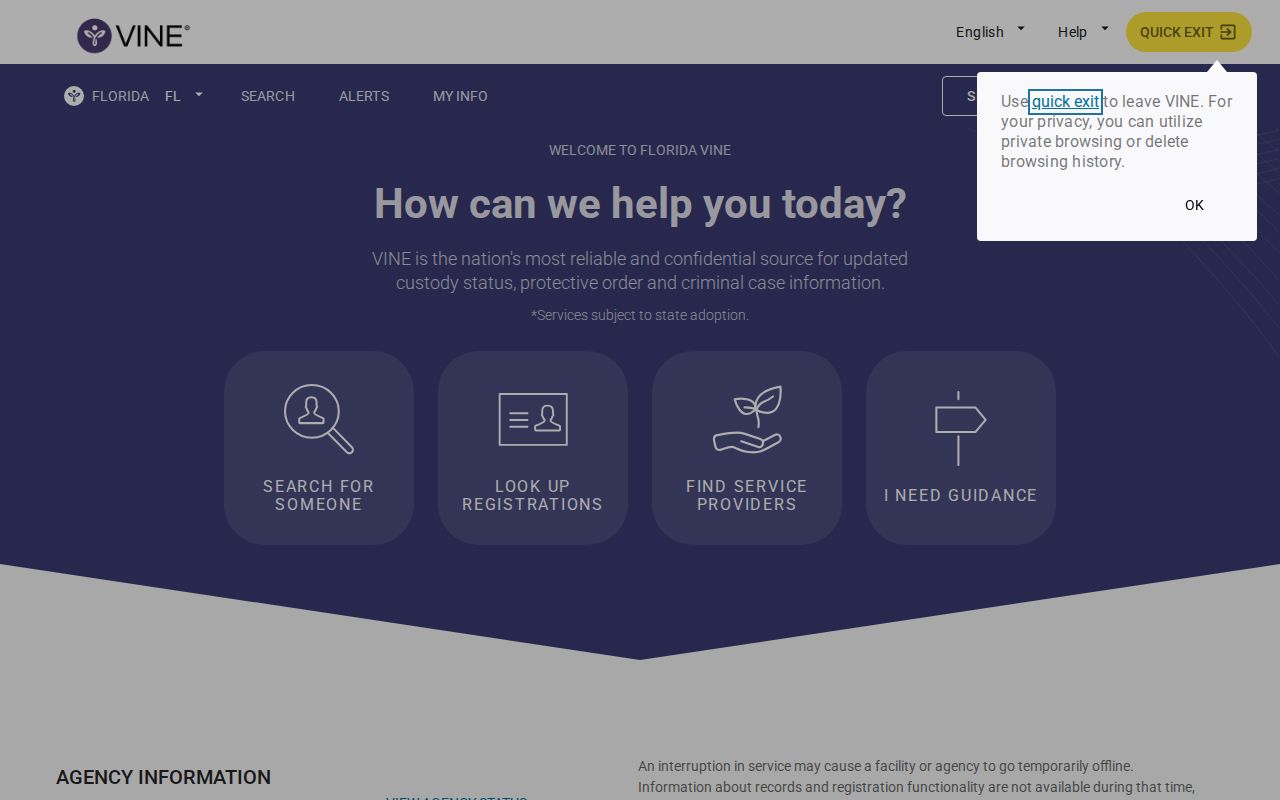
The statewide entry is the correct starting point for county and FDC events. It should not be confused with a county release archive or federal locator.
Search a Brevard VINELink Record
Search one person at a time and verify the match. Common names can produce more than one result, and a person may have records from different reporting agencies. The Brevard County released-inmate search path adds the direct BCSO, court, and receiving-agency steps when VINE alone cannot answer the release question.
- Open the Florida person search.
- Enter the exact name or an offender or ID number. Avoid relying on a partial-name match alone.
- Compare age or birth date, sex, agency or facility, and offender number before selecting a result.
- Open the matched detail and treat the reporting agency and custody status as the controlling fields.
- If a release event appears, record its date and agency, then confirm with BCSO, FDC, or the likely receiving system.
The official one-person search screenshot shows the Florida fields used to narrow a match.
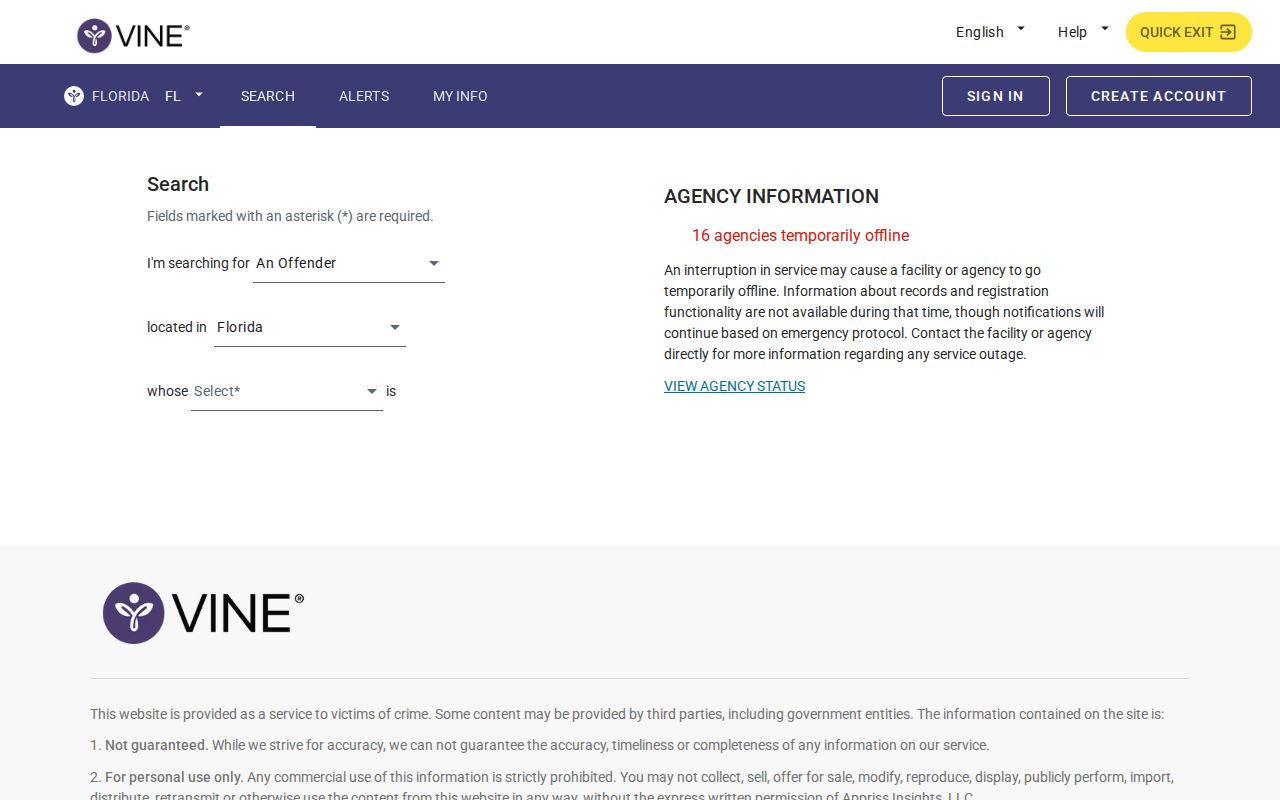
Identity checks reduce the risk of assigning a custody event to a namesake. A no-result is not affirmative evidence of release.
Brevard VINELink Release Fields
County fields can vary with the jail's feed. FDC's official program material supports current location and tentative release information for state inmates. Read every field in the context of the reporting agency, because a future projected date is not a completed release.
| Field | How to read it |
|---|---|
| Name and offender ID | Use both to confirm the correct person. |
| Reporting agency | Identifies whether the event came from BCSO, FDC, or another source. |
| Custody status | Shows the agency's current reported status, subject to feed lag. |
| Facility or location | Indicates where the source reports the person, if available. |
| Release or event date | Marks the reported change, not necessarily a community return. |
| Tentative release | A projected FDC date that can change and does not prove release occurred. |
VINE is a present-status and notification tool. It is not a certified, permanent release history. For a BCSO booking, obtain the county release record when the exact time, reason, authority, or destination matters. For a state prisoner, use FDC's released-inmate search after the event.
Note: A release notice confirms the source's reported event, but transfer to another agency can end one custody status without ending all custody.
Register Brevard Release Alerts
Registration begins from the correct matched record. Florida permits phone and email or text channels. The four-digit PIN is for automated phone-call acknowledgment. The state form does not say that email needs that phone PIN.
- Select Notify Me of Status Changes from the matched detail.
- Add the desired phone number and/or email or text destination.
- For automated calls, choose a four-digit PIN that is not sensitive. If none is chosen, Florida's form says the default is the phone number's last four digits.
- Review the confirmation screen and select the control that affirms registration.
- Keep the registration details available so a phone notice can be acknowledged correctly.
Florida states that automated calls repeat until the PIN is entered, while text and email notices do not repeat. The toll-free Florida VINE line is 1-877-846-3435 and is available at all hours. Direct phone lines work better than switchboards or call-announcement services.
The Florida registration form documents phone, text, email, confirmation, and PIN rules.
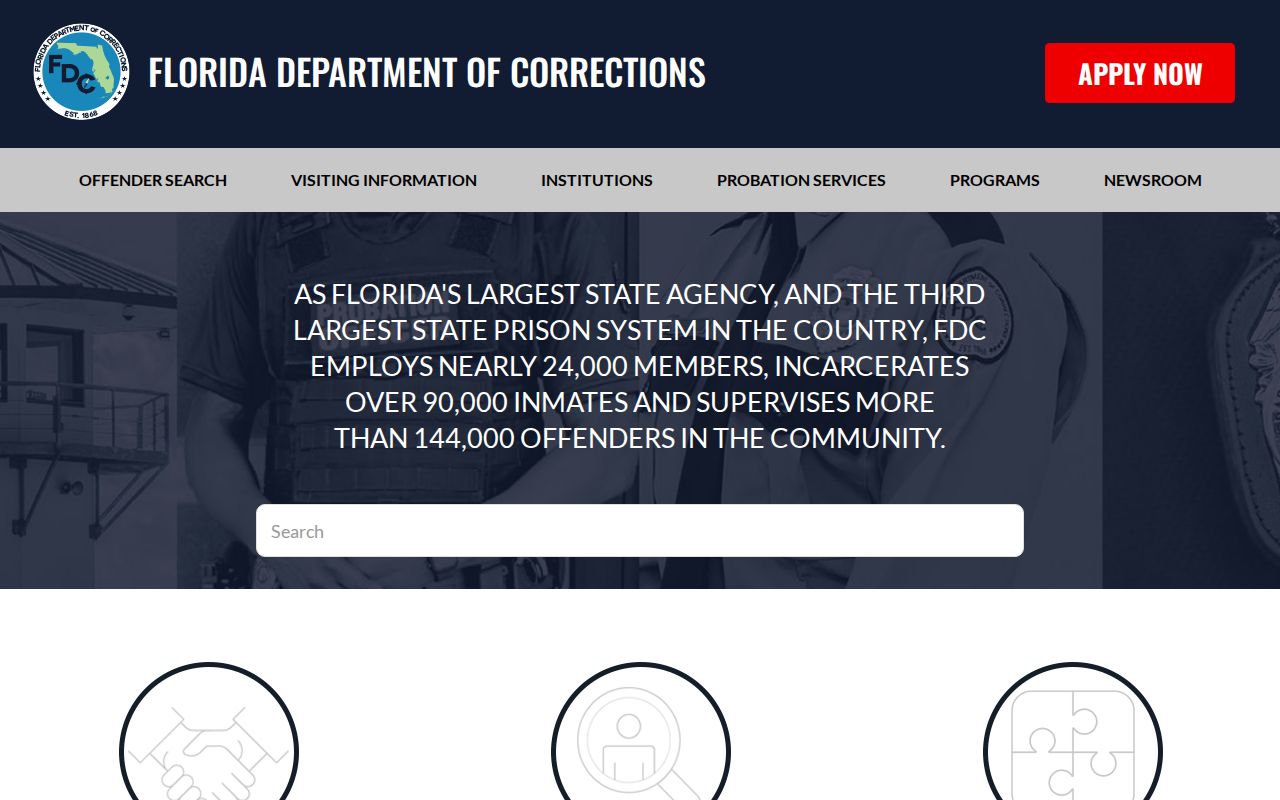
The form supports a key channel difference: phone calls need PIN acknowledgment, but electronic notices do not repeat.
Confirm Brevard VINELink Releases
Feed delays, exact-match problems, transfers, suppression, or retention behavior can cause a missing or changed result. Do not infer release from disappearance. A positive release event also needs context. Check BCSO for a county booking, FDC for state custody or supervision, and a receiving system when transfer is plausible.
BOP maintains its own locator for federal inmates. ICE has the Online Detainee Locator for public custody queries. A USMS detainee may be housed in a local or state facility, and the Marshals Service has no general public person locator. Juvenile and exempt information may not appear publicly.
FDC's Victim Services and VINE registration page explains the state program and its separate registration route.
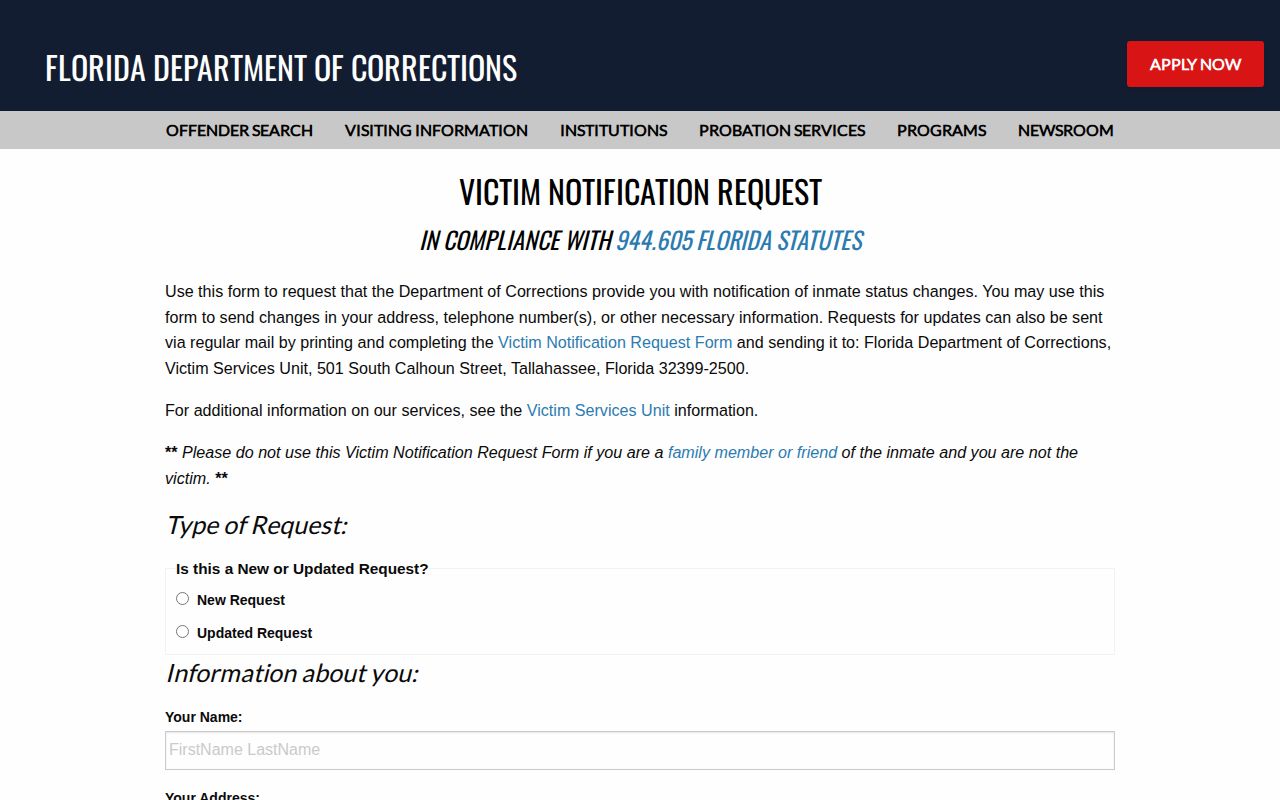
The state page also makes clear that direct VINE registration is separate from FDC's own victim-notification database.
Brevard County and FDC Events
Agency scope determines what a VINE event means. BCSO reports county-jail custody changes. FDC reports state-prison and community-supervision events. A person booked at the Brevard County Jail Complex may later enter FDC custody, which can create a new state record without making the earlier county record wrong. Search both sources when the court sentence or transfer paperwork points to state prison.
For a released county detainee, the BCSO detail can show Released: Yes and a date, but the formal release record is the route to time, method, authority, detainers, and destination. For a former state prisoner, FDC's Inmate Release Information Search is the after-the-event record search. Its Supervised Population Search can then show whether community supervision follows. Physical release and discharge from all supervision are different events.
A person still shown in the current BCSO or FDC custody source has not been verified as released. Conversely, absence from a live list proves little on its own. VINE should prompt the direct source check, not replace it. This layered reading prevents a projected date, transfer notice, or stale result from being mistaken for a completed release.
Brevard's Two VINE Systems
Brevard's documented immigration handoff path makes system names especially important. Florida VINE is open statewide for county-jail and FDC events. DHS-VINE is a separate, eligibility-limited program for qualifying immigration crime victims, witnesses, and authorized people who seek ICE custody, release, or removal notices. One registration does not enroll a person in the other.
ICE's Online Detainee Locator is a third system and serves as the public locator. It is not an alert registration. A BCSO release can be an ICE handoff, so pair the county record with the destination and immigration tool before concluding that the person entered the community.
The DHS-VINE service shows the distinct immigration notification layer.
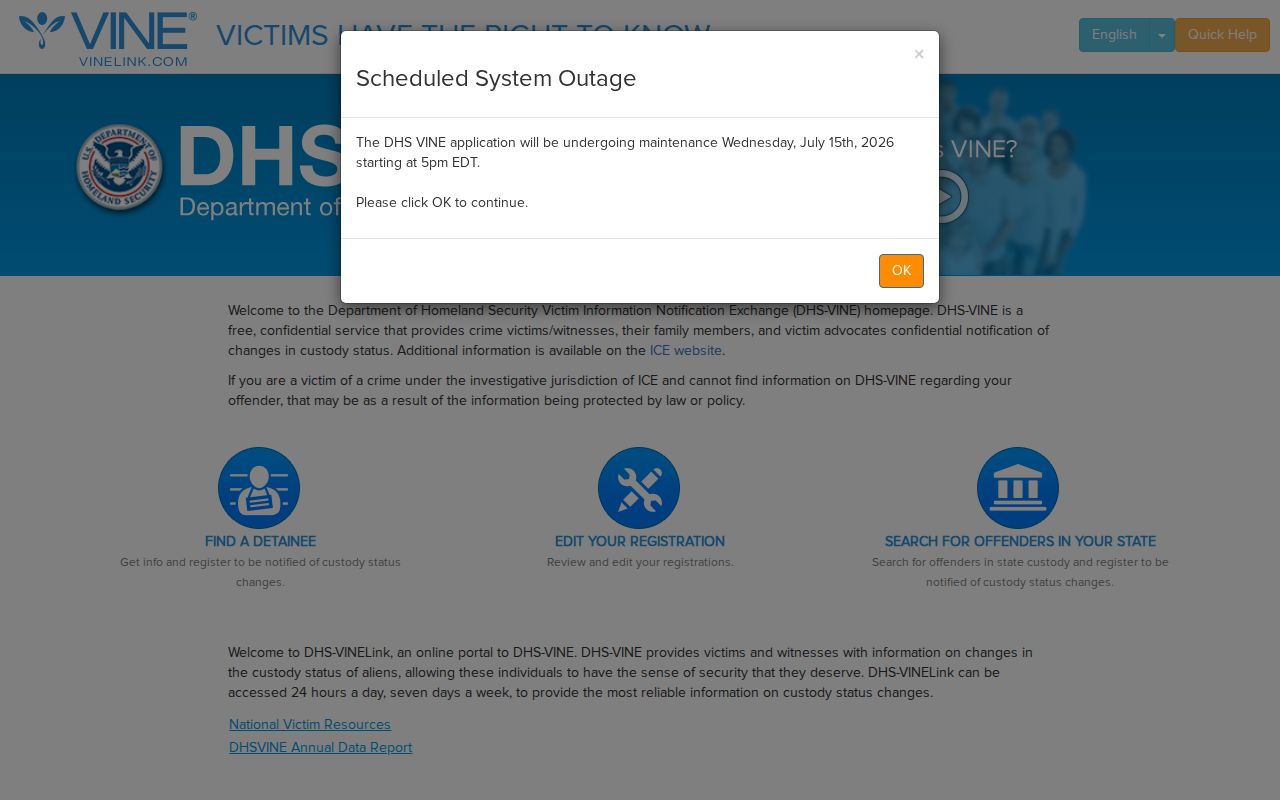
The screenshot belongs only to the DHS program. Florida VINELink, DHS-VINE, and ICE's public locator use different data and instructions.
DHS-VINE access is not open on the same terms as Florida VINELink. Its alerts concern ICE custody, release, or removal for eligible registrants. ODLS, by contrast, is the public person-locator route and has its own search rules. If BCSO release paperwork identifies an immigration transfer, use the destination and ODLS first, then use DHS-VINE only if the person seeking alerts meets that program's eligibility rules.
Brevard Release Registry Limits
The FDLE Sexual Offenders and Predators Search is a limited post-release route for people who have a statutory registration duty. It is not a general list of released Brevard County inmates. A registry match should be checked by identity, status, and location, and it should never be used to fill a gap in the ordinary VINE search.
BCSO registers qualifying people through the SORT Unit at the Jail Complex. Certain registrants must report in person within 48 hours after release from FDC, DJJ, or other custody or supervision. The published registration office number is 321-206-9433, with weekday hours from 8 a.m. to 3 p.m. excluding holidays. This local duty does not mean every person released in Brevard appears in the registry.
Registry status and VINE status answer different questions. The registry concerns a limited statutory population and ongoing duties. VINE concerns agency-reported custody and supervision events. A registry record may remain active after all confinement and supervision have ended, while a VINE event may describe someone who has no registry duty at all. Keep the systems separate and verify the exact event with its originating office.
The local registration office is therefore a specialized contact, not a general inmate-information line. It cannot replace BCSO Inmate Records for an ordinary county release, FDC Admission and Release for a state discharge, or the Florida VINE line for an alert registration. Routing the question to the office that owns the event keeps a registry duty from being mistaken for custody status.
When Brevard VINELink Finds Nothing
Start by checking spelling, name order, and the offender or ID number. Search results may depend on an exact match, and a person with more than one agency record may require a different identifier. If the person was booked only recently, allow for source-feed lag but do not assume any specific update time that the agency has not published.
Next, return to the source system. Search the BCSO person detail for a county booking. For state custody, choose the correct FDC population: current inmate, inmate release, supervised population, or absconder. A former state prisoner may appear in both the release search and supervision search. A county detainee who never entered FDC may appear in neither.
Finally, use the records office when a no-result remains unexplained. Ask BCSO about the exact booking through its public-record portal, or ask FDC about the state record. The Brevard Clerk case search can show a release order or sentence, but it does not prove when staff completed the physical release. The release record remains the sound confirmation when a missing VINE result conflicts with other facts.