
Brevard Parole and Probation
Several Florida statuses are often called parole even though they arise from different orders. The Florida Commission on Offender Review, or FCOR, decides discretionary parole and other Commission release programs. Florida Department of Corrections Probation and Parole Field Services performs the day-to-day field supervision. A sentencing court imposes probation. Brevard County Community Corrections, meanwhile, monitors some defendants released before their cases are resolved. Leaving the Brevard County Jail Complex does not identify which of these statuses applies.
The source of the order matters. State parole follows a state-prison sentence and is now largely limited to older statutory categories. State probation can follow a court sentence without parole. Pretrial supervision keeps a pending Brevard case under court control and is neither sentence completion nor state parole. The comparison below points to the record that should be checked.
| Status | Who orders it | Where to verify |
|---|---|---|
| Parole | Florida Commission on Offender Review | FCOR order, FDC release search, then FDC supervised population |
| Probation | Sentencing court | FDC supervised population and the Brevard court docket |
| Conditional release | FCOR under a statutory release program | FCOR action and FDC supervision record |
| Pretrial supervision | Brevard court and Community Corrections | Brevard court docket and county Community Corrections |
- Parole
- Conditional community release authorized within a qualifying state-prison sentence.
- Probation
- A court sentence served under stated rules in the community.
- Discharge
- The recorded end of a supervision term, not merely release from a jail or prison.
- Absconder
- A person whose location is unavailable to supervision and for whom a violation warrant has issued.
Verify Brevard Post-Release Supervision
The FDC Supervised Population Search is the main public route for state supervision and interstate-compact cases. It does not cover Brevard County pretrial supervision. A result may show the person's identifiers and photo, Current Location, Current Status, Supervision Type, Scheduled Termination Date, aliases, and community-supervision history. Current Location identifies an office or circuit, not the person's home.
- Search by DC number when it is known. Otherwise use the full name and compare date of birth, photo, aliases, sex, race, and case facts.
- Read Supervision Type and Current Status. Do not infer parole from the mere fact that a person is supervised.
- Check the Scheduled Termination Date, but treat it as scheduled until the record shows discharge.
- Match the county, case number, offense date, sentence date, and supervision history with the Brevard court docket.
- If the record suggests prison release, verify actual departure in FDC's release search. For county pretrial monitoring, contact Brevard Community Corrections instead.
The FDC offender-search menu keeps current inmates, released inmates, supervised people, and absconders in separate searches. That division prevents a common error: absence from one population is not proof of release or discharge. The broader Brevard County released-inmate search path explains how the BCSO booking and court record fit beside the state systems.
The official supervised-population screen shows the fields used for that check.
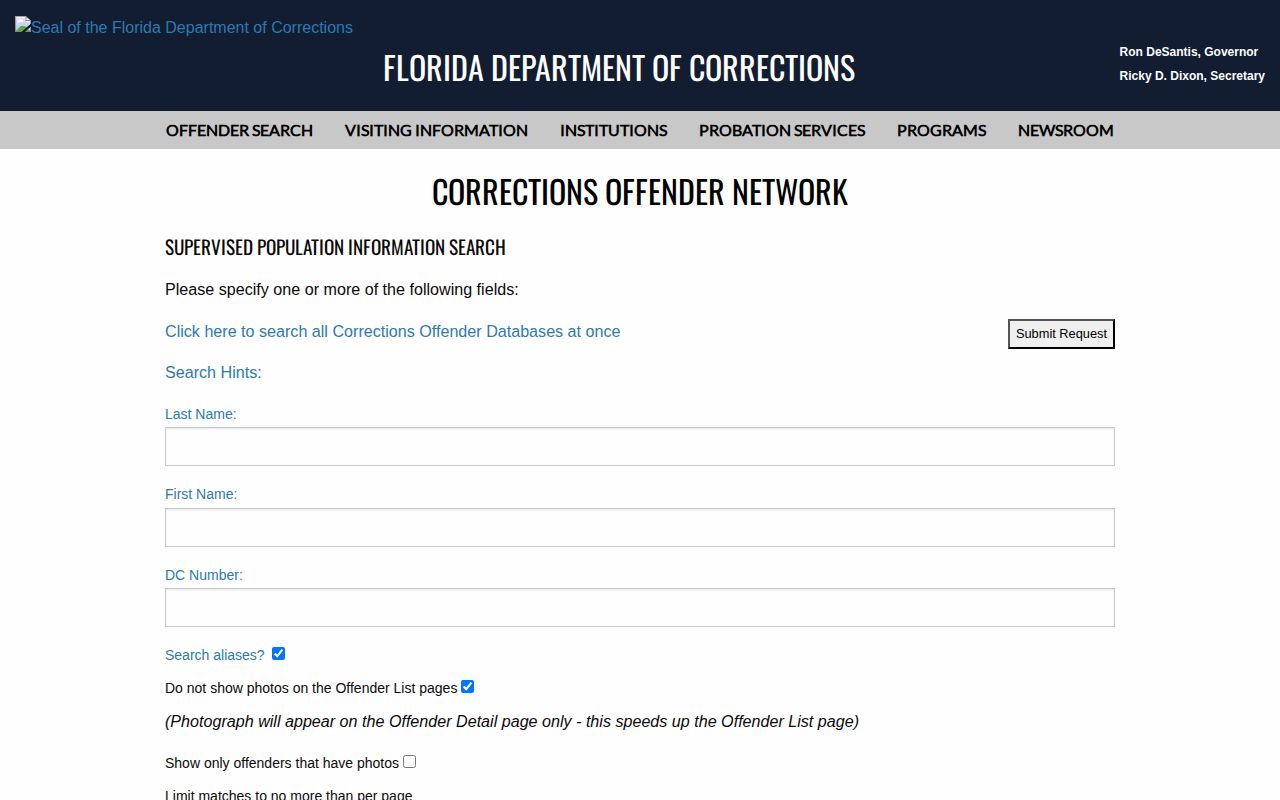
Use the screen for a matched state-supervision record, then confirm any legal conclusion with the court or supervising agency.
The official FDC search menu also makes the population choices visible.
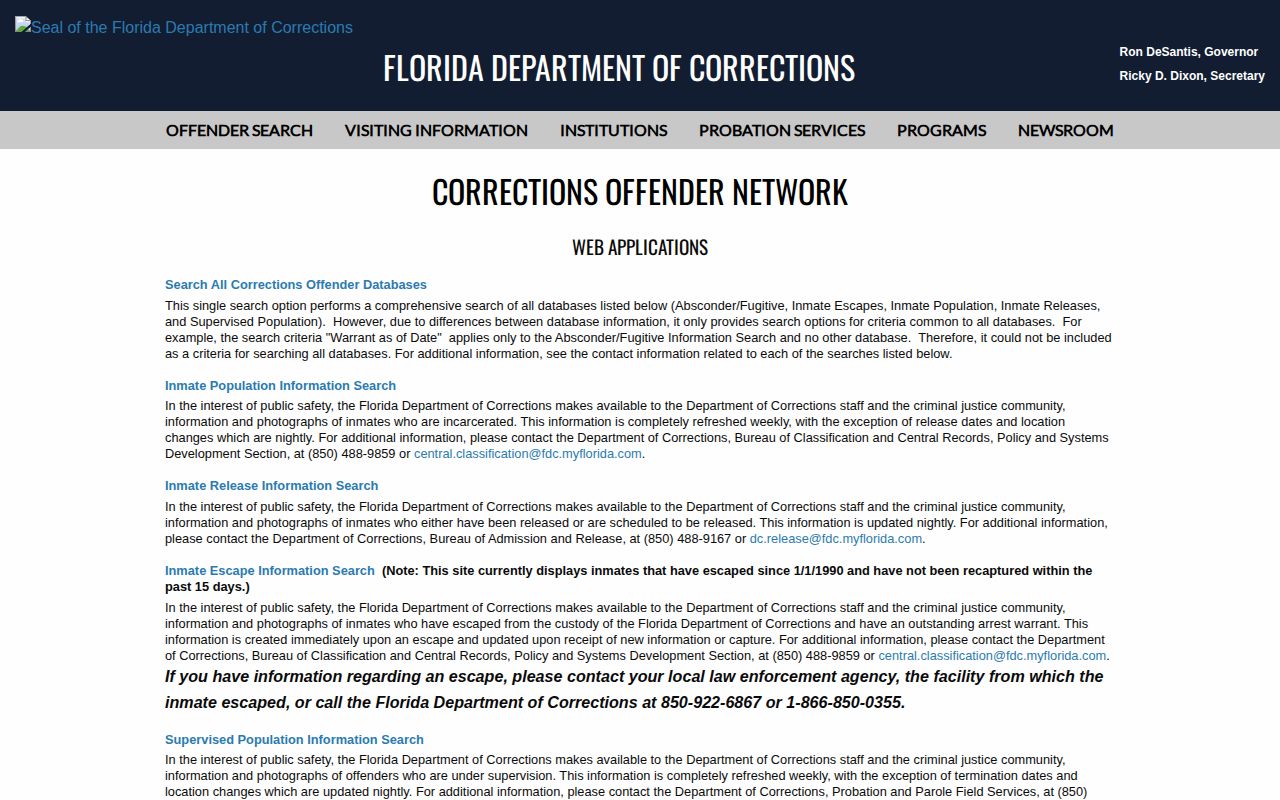
Selecting the supervised population instead of the current-inmate list is essential when checking a person living under community supervision.
Note: State supervision data often refreshes weekly, while termination dates and office changes are reported as nightly updates.
Brevard Probation Office Routing
Brevard County is part of FDC Circuit 18 in Region 3. Search the person first so the listed Current Location can guide the call. A field office can route reporting or verification questions, but confidential case details may remain restricted. The official Melbourne Circuit Office directory also identifies nearby units.
FDC Melbourne Circuit Office
2325 South Babcock Street
Melbourne, FL 32901
321-608-9740
Other listed Brevard units:
Titusville: 3880 South Washington Avenue, Suite 106, 321-264-4073
Melbourne Unit 181: 1500 West Eau Gallie Boulevard, Suite B-1, 321-752-3145
Cocoa Intake: 1060 West King Street/SR 520, 321-634-3570
FDC Probation and Parole Field Services also lists 850-717-3444 and co-supervision@fdc.myflorida.com for supervised-population questions. Those contacts address state supervision. They should not be asked to resolve a county-only pretrial record.
Brevard Supervision Status Terms
FDC's status labels carry specific meanings. Active means the person is being supervised in the community. Active Suspense means the person is temporarily unavailable for direct supervision, perhaps because of a jail or other facility placement, while the officer continues to monitor the event. Absconder means the person's whereabouts are unknown or unavailable and a violation warrant has issued. None of those labels should be rewritten as a successful discharge.
Use the separate FDC Absconder/Fugitive Search when that status is relevant. FDC lists its Absconder Unit at 850-717-3475 on weekdays from 8 a.m. to 5 p.m. Because a public search can lag, confirm a current warrant with the responsible agency or court before relying on it. Conditions and violations belong to the sentencing order, FCOR order, and current supervision record rather than a general jail roster.
The official absconder search shows the dedicated state route for this status.
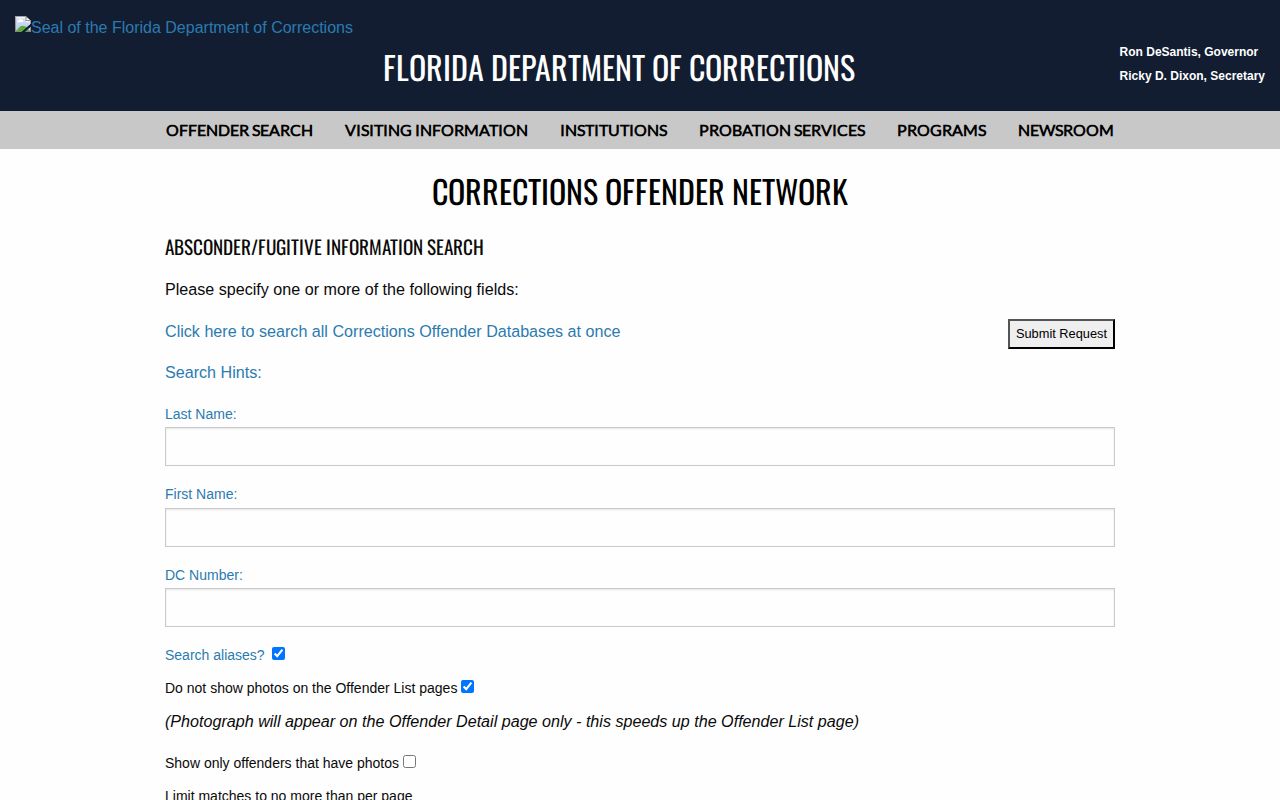
A match should lead to agency and court verification, not an assumption based only on a name.
Florida VINE can send notices for some state community-supervision events, including absconding, return from absconder status, a supervision change, or death. It is a notice service, not the final legal record. A VINE alert should lead back to FDC and the court or Commission action that created the status.
Brevard Supervision and Discharge
Release from a prison and discharge from supervision can occur on different dates. The FDC Inmate Release Search records the prison departure. The Supervised Population Search supplies the current community status and scheduled termination date. A final court order or FCOR action may be needed to show why the term ended. When the public released detail omits the legal release mechanism, request the admission-and-release record or Commission order rather than assigning a label from the date alone.
Conditional release illustrates the distinction. Under Florida law it is mandatory post-prison supervision for specified qualifying prisoners at the applicable release point, with conditions set by an FCOR panel. It is not ordinary parole. FCOR also administers specifically named programs such as conditional medical release, addiction-recovery supervision, and control release. Each status must remain tied to its own order and program name.
Florida public-record law generally permits inspection and copying, subject to exemptions. A custodian may redact protected material and must cite the basis for withholding it. No single statewide response deadline applies; Chapter 119 calls for prompt, good-faith access within a reasonable time. Ask FCOR for the action, order, or vote sheet when the public search does not establish the end of supervision.
Note: A scheduled termination date is useful for planning a follow-up check, but it is not a substitute for a discharge entry.
Brevard Parole Hearing Records
FCOR publishes a live Commission voting schedule. Selecting a date opens an agenda with hearing time, title, location, person name, DC number, category, full-Commission or panel grouping, county, offense, and case number. The current schedule controls the cadence. The Commission states that in-person parole hearings normally occur Wednesday mornings, with some Thursday video or teleconference follow-ups.
An agenda is a docket, not a results page. Its category does not show whether FCOR granted, denied, deferred, modified, suspended, or rescinded a release date. The Brevard entry on the January 7, 2026 agenda demonstrates the searchable identifying fields, but it cannot be cited as the vote outcome.
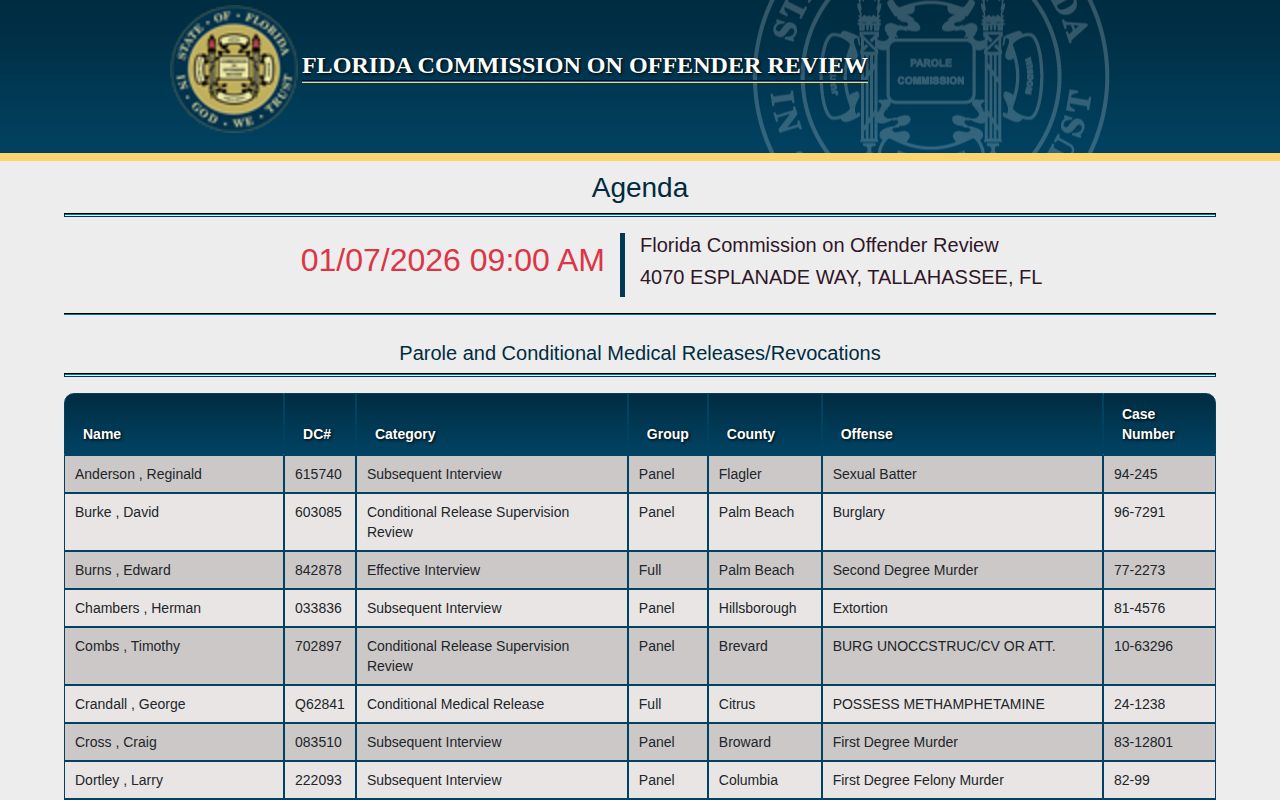
The displayed category and grouping organize Commission work; the later action or order supplies the result.
The Commission schedule provides the best public view of upcoming voting activity.
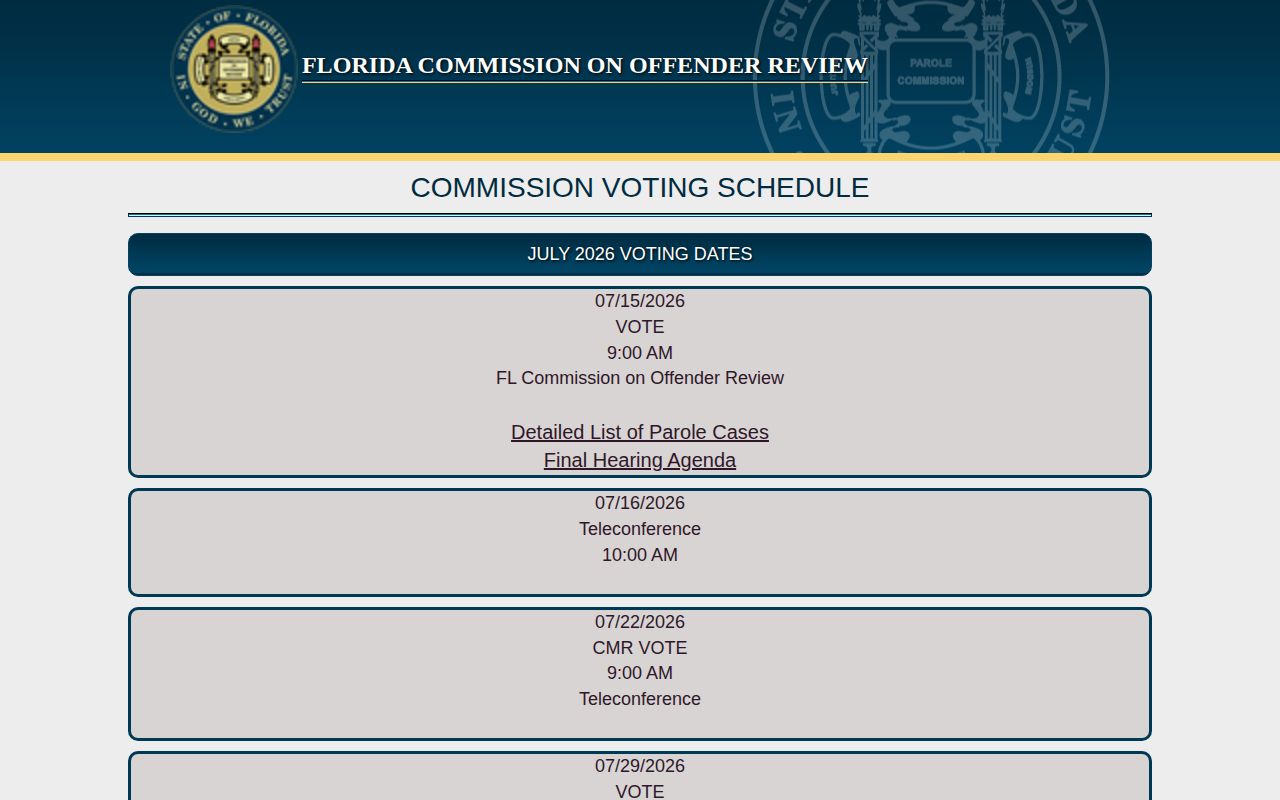
After locating a person and date, request the resulting Commission action and then check FDC for actual release and supervision.
Brevard Parole Outcome Limits
No official public person-name database of FCOR decisions or results was found in the research sweep. To learn an outcome, request the Commission action, order, or vote sheet through FCOR public records. Parole decisions may establish or modify a presumptive parole release date, called a PPRD. Later action can defer, suspend, modify, or rescind that date. Before departure, FCOR may set an effective parole release date, or EPRD.
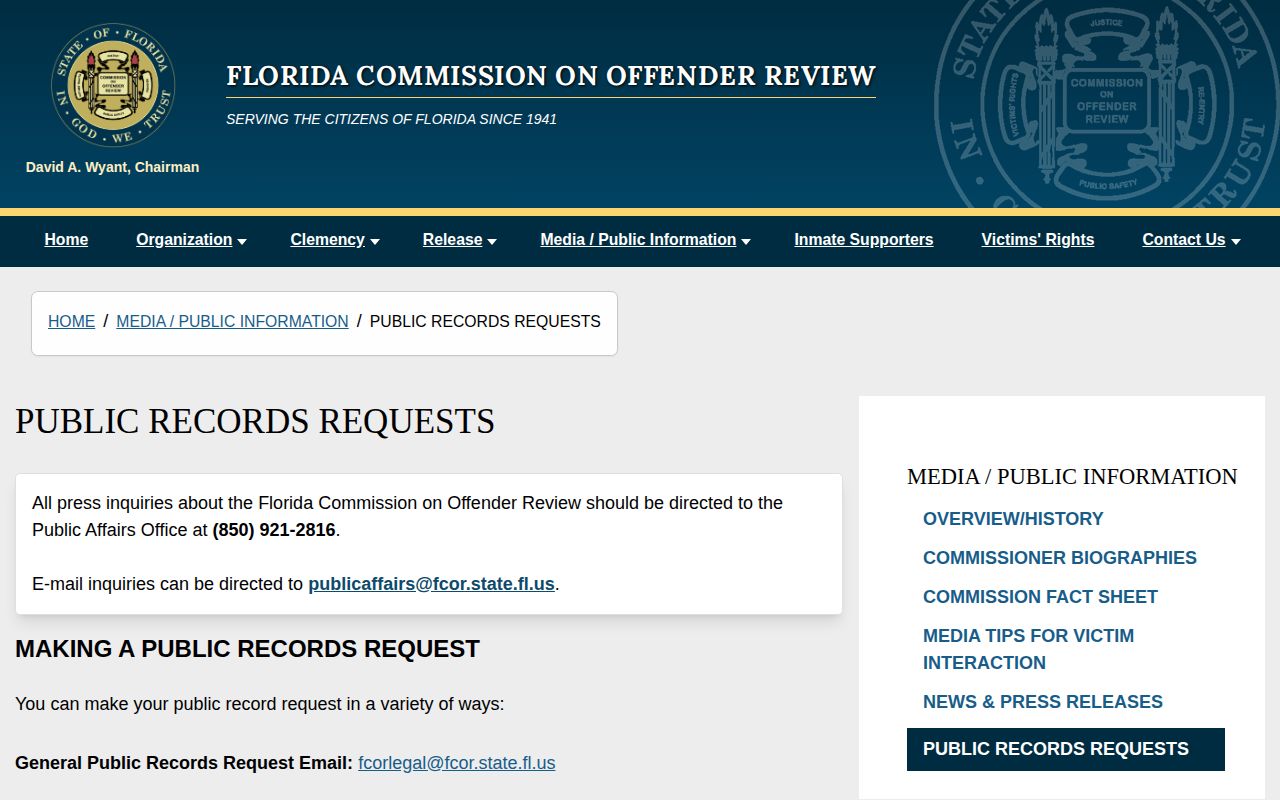
The records-request route is the supported way to obtain a decision when the public agenda supplies only the docket.
Neither a PPRD nor an EPRD proves that the person left prison. The durable check uses the FCOR order for the decision and conditions, the FDC Inmate Release Search for actual departure, and the FDC Supervised Population Search for the current community status. Revocation and conditional-release matters have distinct orders, so a generic outcome label can be misleading.
Ordinary Florida parole is mainly a legacy regime. Eligibility turns on offense date, sentencing rules, and narrow statutory categories. Sections 947.16, 947.172, 947.174, and 947.1746 govern interview timing, recommendations, later interviews, and effective dates. Eligibility means that FCOR may consider release. It does not promise release, and a hearing date is not a custody-change record.
Brevard Pretrial Release Supervision
Brevard Community Corrections monitors some defendants who have left the jail while their criminal case remains pending. Jail Oversight reviews recent arrests for possible release consideration. Approved defendants are often placed on Pretrial Community Supervision. That status is not probation after conviction, state parole, or proof that a sentence has ended.
Brevard Community Corrections
Pretrial Release/Community Supervision
571 Haverty Court
Rockledge, FL 32955
Officers: 321-985-5695 or 321-985-5696
Jail Oversight coordinator: 321-985-5702
The county Community Corrections page is the appropriate local source. Pair it with the Brevard court docket for the release order and current case status. Do not look for this county layer in the FDC Supervised Population Search.
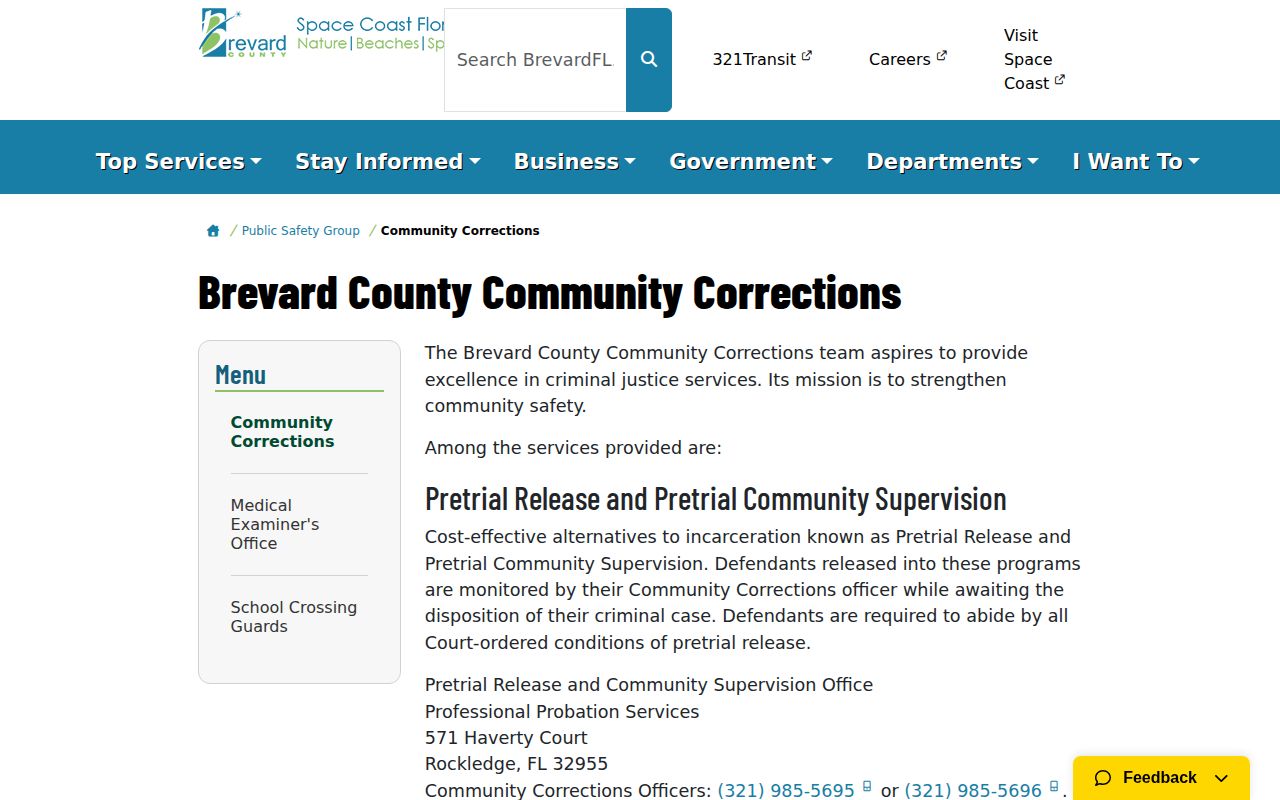
The county contact source confirms that pretrial supervision belongs to a separate Brevard release pathway.
After a Brevard Release
A released Brevard inmate has up to 30 days to download photos, messages, and scanned postal mail from SmartJailMail without charge by using the former inmate credentials. This short post-release window is separate from probation or parole, but it can matter while a person is arranging reporting, court follow-up, and personal records.
Physical property follows different routes. BCSO permits authorized third-party pickup during limited Tuesday, Wednesday, and Thursday windows described in the Jail Complex FAQ. Evidentiary property is handled by another BCSO unit and requires an appointment. SmartJailMail data, stored personal property, and evidence should never be treated as one request.