
Juvenile Center Release Route
The Brevard Juvenile Detention Center is a secure Florida Department of Juvenile Justice facility. It serves youth who may be awaiting adjudication, disposition, or commitment placement. Adjudication is the youth-court decision on whether the allegation is proved. Disposition is the order that follows and sets the next legal step. Commitment is a DJJ placement ordered by the court, not a county adult-jail sentence.
A youth can leave secure detention for home detention, another DJJ placement, a treatment setting, conditional release, probation, or another court-directed result. The exact path depends on the court order and assigned DJJ case team. For that reason, a physical departure from this center may not mean the youth is free of all DJJ or court control. Authorized parties should ask which agency or program received responsibility and what order governs the move.
Confirm a Juvenile Release
Begin with the contact already assigned to the youth. That may be a DJJ juvenile probation officer, community-intervention staff member, defense counsel, parent or guardian contact, or juvenile-court clerk route. The facility can explain its identity and authorization process, but it may not disclose custody facts to the public. These limits protect youth records and should not be read as evidence that no record exists.
- Gather the youth's full legal name, date of birth, case number if known, and the caller's relationship or legal authority.
- Call the Brevard Juvenile Detention Center or the assigned DJJ contact and ask what proof of authorization is required.
- Confirm whether the event was release from secure detention, transfer to another placement, home detention, conditional release, probation, or final case closure.
- Use the juvenile-court case number and authorized court channel for the signed order or disposition.
- If counsel is involved, route detailed record questions through counsel rather than seeking an adult public-roster result.
Ask narrow questions. The most useful facts are the date secure detention ended, the court or DJJ authority for the move, the receiving placement if disclosure is permitted, and the next reporting obligation. A general request for every juvenile record is more likely to include protected material and require added review.
Note: A facility may verify the correct process without confirming that a named youth is or was held there.
Juvenile Center Release Contact
The official DJJ facility page identifies the center, its operator, location, phone number, secure capacity, and role. Use that official contact to learn what documentation an authorized parent, guardian, lawyer, or other representative needs. Do not assume that the adult jail's 24-hour information line can answer a DJJ case question.
Brevard Juvenile Detention Center5225 Dewitt Avenue
Cocoa, FL 32927
Phone: 321-690-3400
Agency: Florida Department of Juvenile Justice
The official facility information appears in the matching source capture below.
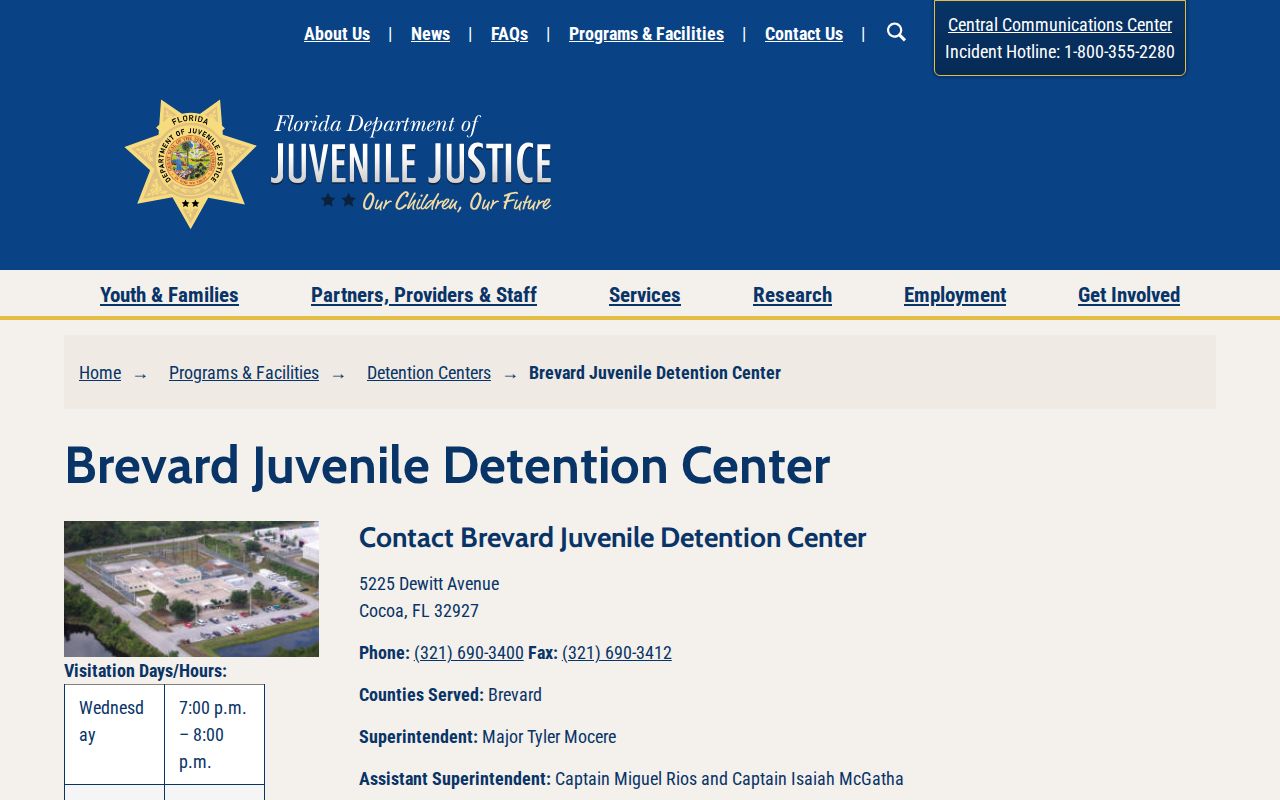
This source confirms that the center is a DJJ secure detention facility and supports the youth-specific contact route, not an adult inmate-search route.
Juvenile Center Detention Role
DJJ identifies the Brevard center as a 40-bed hardware-secure detention center. Hardware-secure means that secure physical features and controlled access are used to hold youth under juvenile-court authority. The agency describes an approximate 11-day average secure-detention stay. That average is descriptive, not a promise for any individual case.
Release timing depends on the youth's detention status and court orders. Some youth are held before adjudication. Others await disposition or movement into a commitment program. A transfer from secure detention to another DJJ program is not a final release from the juvenile-justice system, even though the youth has left the Brevard facility.
- Adjudication
- The juvenile-court finding on whether an allegation is proved.
- Disposition
- The court's order setting the youth's legal outcome and next steps.
- Commitment
- A court-ordered DJJ placement that can follow disposition.
- Conditional release
- Community placement subject to stated rules and oversight.
Brevard Juvenile Court Records
The Brevard Clerk explains the county's criminal and juvenile court routing, but juvenile access is not the same as adult criminal case access. The Clerk's court information distinguishes Circuit Court felony jurisdiction, County Court misdemeanor and criminal-traffic work, and juvenile matters within the court system. An authorized person should provide the case number when seeking an order.
The captured Clerk source helps show why an adult docket search cannot simply be copied into a juvenile release inquiry.
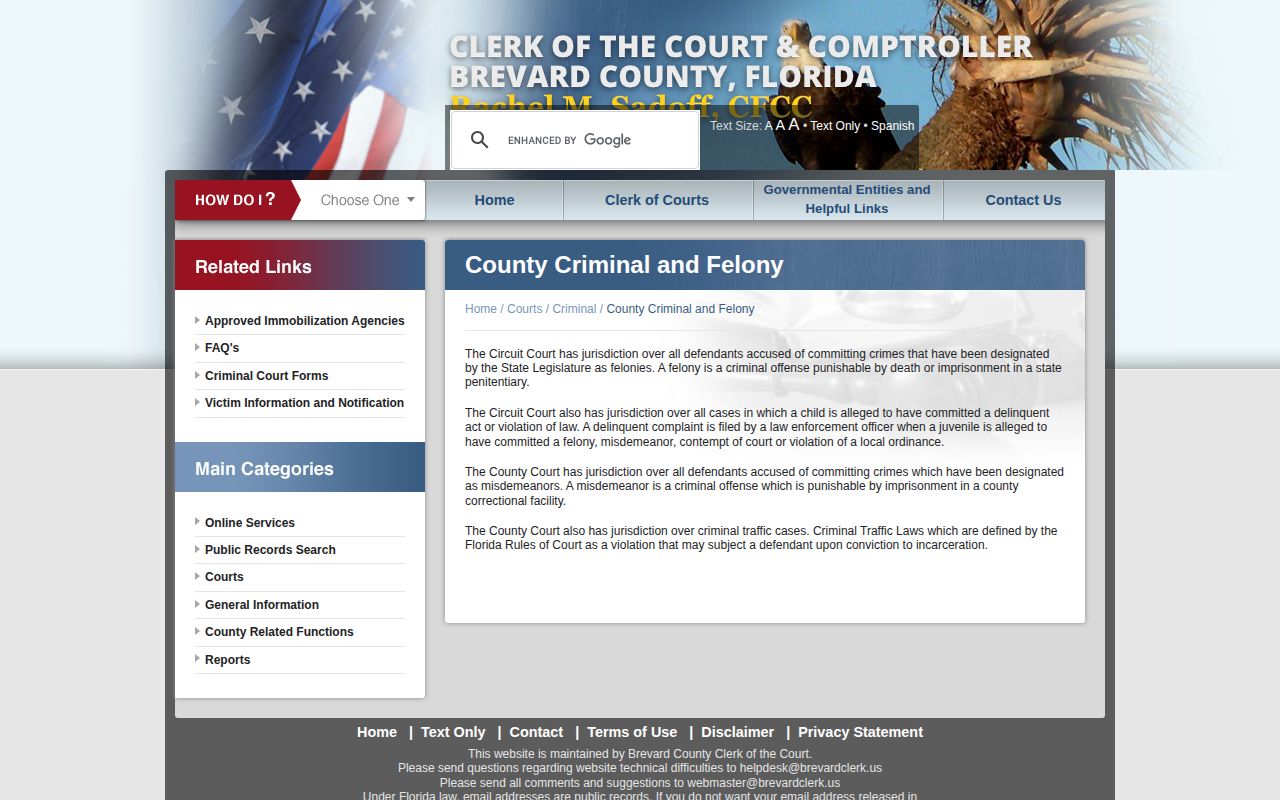
The court route can supply the controlling order when access is allowed, while DJJ explains the placement and reporting process for the youth.
A signed order is stronger than a secondhand account. It can show whether secure detention ended through release, home detention, transfer, probation, or another disposition. Some portions may remain confidential or available only to parties, counsel, guardians, and other authorized persons.
The court and DJJ records answer different parts of the question. The court order supplies the legal authority and disposition. DJJ can identify the assigned placement, program, or officer within the limits of the caller's authorization. Counsel can reconcile the order with later changes. Combining those sources is safer than asking the adult Clerk search or BCSO booking system to stand in for a confidential youth file.
Juvenile Release Confidentiality
Florida public-record access is broad, but it contains specific exceptions. Juvenile information is among the areas with sharper limits. Other restrictions may protect victims, witnesses, medical and mental-health information, addresses, identifiers, safety details, and active investigative material. The proper response to a denied request is to ask which legal basis applies and whether any nonexempt portion can be produced.
Confidentiality also calls for restraint in what is requested and shared. Use custody facts only for authorized family communication, case work, legal process, and release planning. Do not publish or circulate a youth's protected details merely because an adult record system would normally show similar facts for an adult.
If a custodian cannot release the requested material, an authorized requester may ask for the specific legal basis and whether a nonexempt portion can be separated. A denial may concern the requester's status, the record type, or protected content within a mixed file. It does not turn the adult inmate database into a valid fallback. Narrow requests for a particular order, date, or placement document are easier to assess than a demand for an entire youth history.
| Question | Best channel |
|---|---|
| Is the youth leaving secure detention? | Assigned DJJ contact or authorized facility inquiry |
| What order controls the move? | Juvenile court and counsel |
| Where must the youth report? | DJJ probation or receiving program |
| May a record be released? | Record custodian after authorization review |
Separate Brevard Release Systems
The adult county jail, Cocoa Bridge, and the juvenile center operate in the same broad Cocoa and Camp Road area. They are not one custody complex. BCSO runs the adult Brevard County Jail Complex. FDC controls Cocoa Bridge's state community release placement. DJJ operates the juvenile center. Location alone does not create shared rosters, records, or release authority.
Use the paperwork's agency name as the first routing clue. An adult county booking goes to BCSO. A state resident at Cocoa Bridge goes to FDC. A youth matter stays with DJJ and juvenile court. The broader Brevard County release-record overview can help identify the agency, but confidential youth details still require the authorized path.
Municipal arrest processing creates another possible source of confusion. Adult municipal arrestees are generally transported into the county jail system, where the booking detail can name the city arresting agency. That countywide adult transport pattern does not describe youth detention. A juvenile case can involve a city police agency while the detention and release authority still run through DJJ and juvenile court.
After Juvenile Center Release
Ask the assigned professional what the next stage is called. Home detention may keep the youth at home under strict conditions before further court action. Probation permits community living subject to court and DJJ rules. Conditional release can follow a residential commitment placement. Transfer means custody or program responsibility moved elsewhere, not that the case ended.
Release planning should confirm the approved adult who may receive the youth, transportation arrangements, medication or property procedures, the next court date, and the first reporting deadline. Those details are case-specific and were not published in the facility research. They must come from current DJJ instructions, the order, and the assigned program rather than from a guessed general schedule.
A departure date should also be described with care. “Released from secure detention” may be accurate while a youth remains subject to home detention, probation, conditional release, or commitment placement. “Case closed” is a different finding and requires the court record. This vocabulary protects the distinction between leaving one building and ending all juvenile-court authority.
Note: The facility's approximate average stay cannot predict an individual youth's court-controlled release or transfer date.