
Cocoa Bridge Release Placement
Cocoa Bridge Community Release Center is an FDC contract community release center operated by Bridges of America, also identified as The Cocoa Bridge. The building is FDC-owned. Its residents remain within the Florida corrections framework while they take part in community work release and transition services. The word release in the program name describes the custody level and placement model. It does not mean the sentence has ended.
A move from a prison institution to Cocoa Bridge is therefore a change of placement. The person may still have an active FDC inmate record and a future Current Release Date. Final release from FDC can later lead to state community supervision, which is a separate stage. Supervision means the person lives outside prison while reporting under legal conditions. Full discharge occurs only when the custody and any supervision term have ended.
| Stage | Correct record | What it proves |
|---|---|---|
| Cocoa Bridge placement | FDC Inmate Population | The person remains in state custody at a community release placement. |
| Physical release | FDC Inmate Release | Shows the state-prison release date after it occurs or a scheduled date. |
| Community supervision | FDC Supervised Population | Shows whether state probation or another supervision term continues. |
| Full discharge | FDC record and order | Confirms the applicable state control has ended. |
Confirm Cocoa Bridge Release
Start at the FDC Offender Search menu. It separates the current Inmate Population, Inmate Release, Supervised Population, and Absconder searches. That menu structure matters here. BCSO's adult county booking search does not control a Cocoa Bridge resident's state placement or discharge merely because both operations are in Cocoa.
- Use the DC number when known. It is more precise than a common name.
- Search Inmate Population to see whether FDC still lists the person in custody and review the institution and Current Release Date fields.
- Search Inmate Release for a completed or scheduled release. Match the DC number, birth information, photo, and sentence history.
- Check Supervised Population after a physical release to determine whether state community supervision continues.
- When the legal release type or order matters, request the admission-and-release summary or related FDC record.
A future Current Release Date is a projection, not proof that the person has left Cocoa Bridge or FDC control. Florida law calls the computed date a tentative release date, and lawful sentence changes, credits, gain-time awards or forfeitures, detainers, and other events may alter it. The after-the-event check is the nightly updated Inmate Release search.
Read identity and status together. FDC recommends the DC number when available; otherwise, narrow a name result with date of birth, sex, race, photo, aliases, and incarceration facts. The release result can show the DC number, release date, photo, and sentence or incarceration history. It may not consistently name the legal release method. FDC also warns that a released record is no longer updated after release, which is why a separate supervision check is needed for the person's current post-prison status.
Cocoa Bridge Contract Record
The state's Cocoa Bridge contract detail documents an active community release arrangement. Contract C2994 permits up to 84 occupied community-work-release beds per day and covers treatment and transition services. It was active through June 30, 2026, then extended from April 13, 2026 through April 13, 2031. Those dates describe the state contract, not any resident's personal sentence or release date.
The matching official capture shows the contract source used to establish the operator and program status.
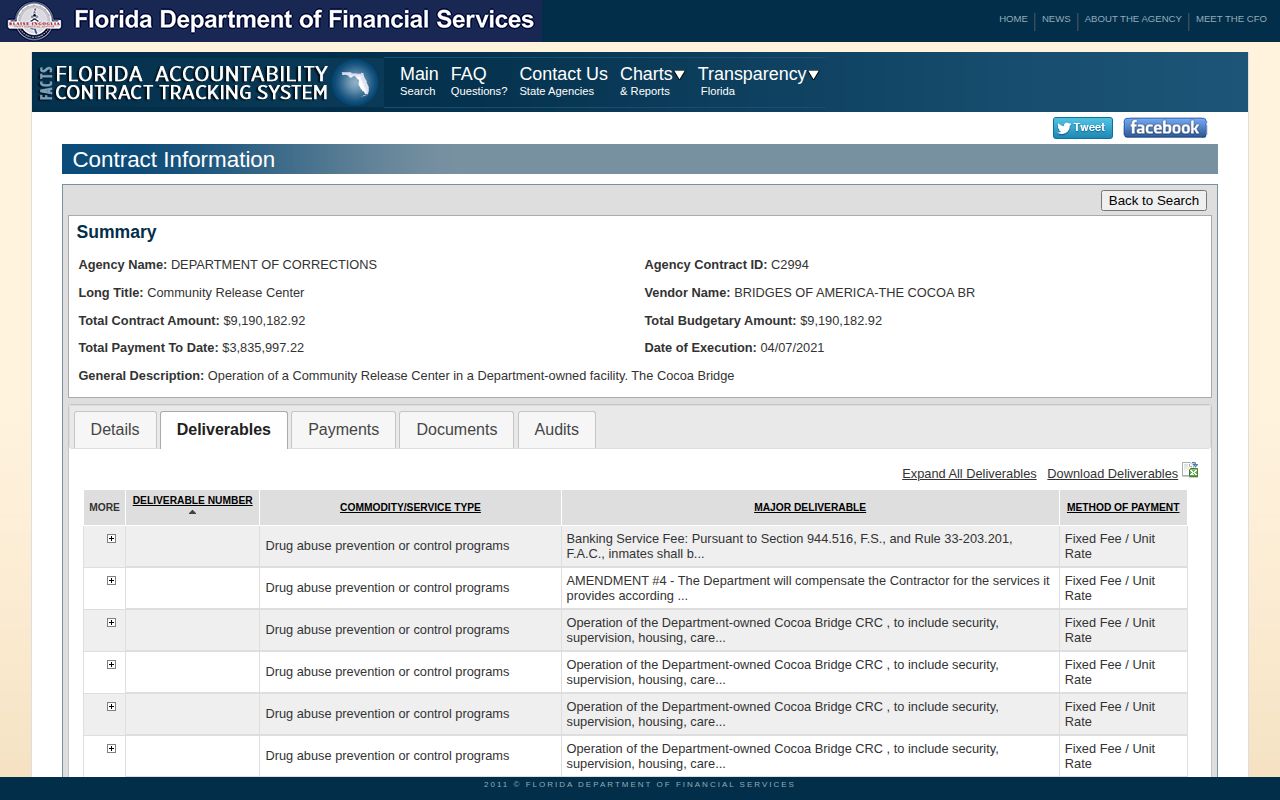
The contract confirms that Cocoa Bridge belongs in the FDC route and helps distinguish a supported community release placement from an ordinary county-jail release.
Cocoa Bridge Release Records
FDC is the records custodian for the state custody event. Use the FDC public-record instructions or its records request center. A focused request names the person, date of birth, and DC number, then asks for existing records rather than an open-ended explanation. Useful items include the admission-and-release summary, release date and type or order, releasing institution, custody in-and-out history, sentence-calculation history, and the applicable photograph.
Some material is protected. Florida law can restrict medical, mental-health, substance-use, presentence, victim, and security-sensitive information. Ask the custodian to state the legal basis for any redaction and release the nonexempt remainder. FDC does not have to create a new record to answer a question, so precise names and document types help.
Florida Department of Corrections501 South Calhoun Street
Tallahassee, FL 32399
Public Records help: 850-717-9774
Bureau of Admission and Release: 850-488-9167
Release email: dc.release@fdc.myflorida.com
Note: FDC Central Records and classification questions may also be routed to 850-488-9859 when the public result needs context.
Cocoa Bridge Location Caution
An older official procurement entry identifies 585 Camp Road, Cocoa. The research source specifically calls for reconfirming that street address before publication, so it should not be presented as a current visitor or release-pickup address. The official property and procurement record remains useful for tracing the state's relationship to the property.
The captured procurement source illustrates the record's role and its age limitation.
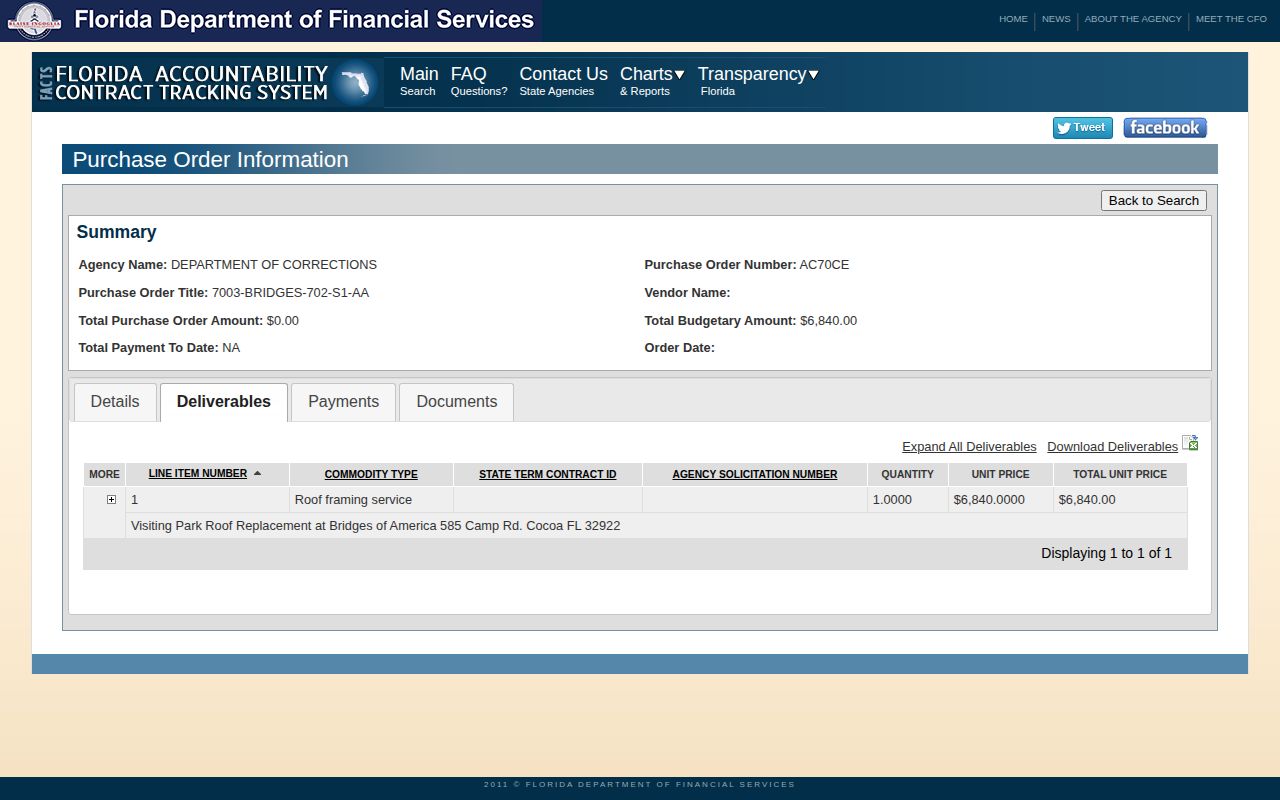
Because that source is not a current public contact page, release verification should go to FDC records rather than relying on the older street listing.
A pickup or reporting plan should be confirmed through current FDC paperwork and the assigned institution or supervision contact. A procurement record can establish public ownership and contracting context. It cannot establish where a particular resident exits, when that exit occurs, or which office manages post-release reporting.
Cocoa Bridge Post-Release Status
Physical departure from Cocoa Bridge may begin another state-controlled phase. Search the FDC Supervised Population system after finding a release entry. The result can show whether a supervision term continues, along with its status and office information. Release from prison and discharge from supervision are different dates.
FDC states that most supervised-population data refreshes weekly, while termination dates and location changes update nightly. Questions about supervision may be directed to Probation and Parole Field Services at 850-717-3444 or co-supervision@fdc.myflorida.com. A failure to find the person in Supervised Population should be checked against the release record and any court or Commission order before concluding that every supervision duty ended.
Florida's community supervision terms can include probation or post-prison release forms overseen through FDC and, for some cases, the Florida Commission on Offender Review. The public released detail does not always state the legal release mechanism. If that distinction affects a court or records matter, request the FDC release record or the relevant Commission action rather than inferring the answer from a date alone.
- Placement
- The facility or program where FDC assigns a person who remains in custody.
- Release
- The end of physical state-prison custody shown by the applicable FDC record.
- Supervision
- Community-based legal control that may follow physical release.
- Discharge
- The end of the applicable custody or supervision obligation.
Cocoa Bridge Transfer Checks
A state release record should not be stretched beyond the agency event it records. A detainer or transfer can move a person from FDC control to another authority. If the release paperwork identifies ICE, use the ICE locator. If it identifies another jail or federal authority, use that receiving system. The destination field and transfer papers are more reliable than guessing from an absent search result.
Brevard has documented ICE cooperation at the county-jail level, but that fact does not prove an immigration hold for each Cocoa Bridge resident. Ask FDC for the named destination or hold disposition when the public release result is silent. This keeps a county-specific risk in view without treating it as a blanket outcome.
Other transfers require the same source-first approach. A move to another FDC institution remains state custody and belongs in the current inmate record. A transfer to a county jail should be checked through that sheriff. A federal transfer calls for the federal docket, BOP, or the actual detention authority. Each record confirms only its own agency's part of the movement.
Camp Road Custody Boundaries
Camp Road's corrections sites are close in geography and far apart in legal function. The Brevard County Jail Complex is operated by BCSO for adult county custody. Cocoa Bridge is an FDC community release placement. The nearby juvenile center belongs to DJJ. Each uses different records, access rules, and release authorities.
For that reason, the Brevard County release search separates county, state, juvenile, and federal paths. Start with the agency named on the paperwork. Use BCSO only for a county booking, FDC for Cocoa Bridge and state discharge, and DJJ or juvenile court for a youth case.